Witchcraft and Self-Care
- Sam Wise
- Aug 22, 2025
- 5 min read

Many of us are drawn to magic, witchcraft, and paganism as a means of self-care. Whether we're living with a disability or chronic illness, struggling to survive and thrive in marginalized identities, or just feeling worn down by the stress of everyday life, we desperately need tools to help us protect our own wellbeing. Spirituality seems like it might be the answer to all our problems.
Here's the bad news: witchcraft and other spiritual practices are not going to magically fix everything. (Pun intended.) But there is good news: Magic can be a powerful tool for healing, and it can absolutely be part of a healthy self-care practice.
The term “self-care” comes from Black activists in the 1970s, who promoted caring for oneself as a way to take back power in a racist society. The Black Panther Party encouraged self-care as a necessary means of self-preservation. They recognized that when the systems that should be taking care of us all are deeply racist, Black people taking good care of themselves and their communities is an act of resistance. The same is true for other marginalized groups, such as disabled people and queer people.
It's important to note that self-care was not originally intended to stand on its own. The activists who popularized self-care also practiced community care and had robust mutual aid networks. Self-care isn't about being totally independent, and it isn't a replacement for getting help from others.
So, how did we get from the Black Panthers using self-care as resistance to influencers selling CBD-infused face masks? In her book, Real Self-Care, author and psychiatrist Pooja Lakshmin, MD, identifies a difference between true self-care and what she calls “faux self-care.”
Faux self-care is a temporary coping method. It might make you feel better in the moment, but it doesn't create lasting positive change. If I'm burned out from working overtime at my job while caring for a sick family member, getting a massage might make me feel better physically and mentally, at least for a few hours – but if I don't cut back my hours at work or get help caring for my family member, I'll still be burned out and exhausted. The relief is only temporary.
Lakshmin defines real self-care as a practice based on four underlying principles:
Real self-care requires you to set boundaries with others.
Real self-care means treating yourself with compassion.
Real self-care means focusing on what matters most to you.
Real self-care asserts your personal power.
In the rest of this post, we'll talk about how to recognize the difference between true self-care and faux self-care. We'll also talk about how to make sure your spiritual practice is a source of true, genuine self-care and not faux self-care.
These topics are big and nuanced, and we are barely scratching the surface in this post. I strongly encourage y'all to do your own research on this topic. Pooja Lakshmin's book is a great place to start.
The following chart from Real Self-Care further explains the difference between faux self-care and practices that are genuinely helpful:
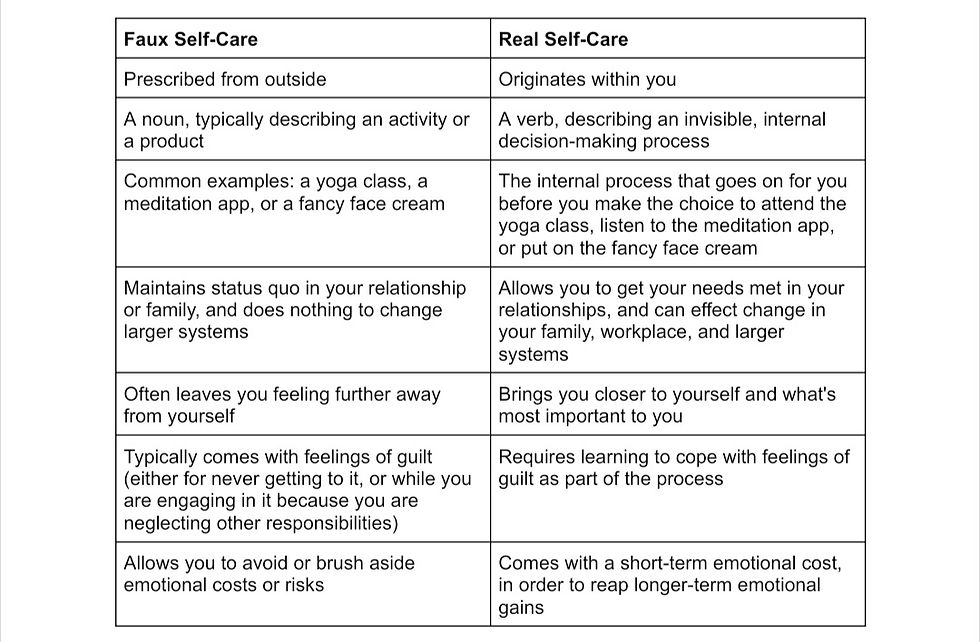
Using this chart, let's look at how witchcraft can be used as faux self-care or as real self-care, depending on how we approach it.
If I am using witchcraft as faux self-care, I am probably drawn to it because someone somewhere told me it would help me. Maybe I have a friend who recently attended a witchcamp or retreat and keeps telling me how life-changing it was. Maybe I follow a witch on social media who makes big claims about magic being able to cure mental illness symptoms. Maybe the owner of my local metaphysical shop told me that working with tarot or oracle cards would accelerate my spiritual development. Whatever the case, I'm coming to witchcraft because of outside influences.
If I am using witchcraft as faux self-care, I am probably using it as an escape from my daily problems. Instead of talking to my partner about frustrations in our relationship, talking to my boss about feeling overwhelmed at work, or telling my family I can't keep dropping everything to help them at a moment's notice, I distract myself with spells and meditations. I tell myself that if I just work through my own internal issues with magic, everything outside myself will somehow fall into place.
If I am using witchcraft as faux self-care, it may not feel authentic to me or may not be what I really want to do with my time. Maybe I would rather unwind after a long day by watching a movie or getting drinks with a friend, but I do a healing spell instead because I feel like it's what I'm “supposed to do” to take care of myself.
If I am using witchcraft as faux self-care, there may be some guilt attached. For example, if I don't have time for a tarot reading before work, I might spend the whole day beating myself up for “skipping self-care.”
On the other hand, if I am using witchcraft for real self-care, I am drawn to the practice because I have a genuine interest in it. Even if I was introduced to witchcraft by a friend or by social media, I have a real desire to learn more about this system. I am coming to it because of my own interests and values, not because someone else told me I would benefit from it.
If I am using witchcraft for real self-care, I am using it to support me in my daily problems, not to escape from them. I can use my spiritual practice to come at the problems of daily life from a place of compassion and wellbeing.
This can be a source of support as I have difficult conversations with the people in my life about things that need to change. For example, I might brew a nurturing self-love potion to help me remain calm and compassionate as I talk to my partner about something that isn't working for me in our relationship.
If I am using witchcraft for real self-care, it feels authentic to me. I am coming to this practice because I want to be here, not because I feel obligated. When I feel like doing something else would serve me better in the present moment, I compassionately step away from my magical practice and do the thing that is best for me right now.
Feelings of guilt may still come up when I set aside time for magic and other self-care practices, because society teaches us that putting ourselves first is selfish. This is especially true for women and femmes, who are often conditioned to be caretakers first and to selflessly set aside their own wellbeing in the service of others.
When we have a real self-care practice, we are able to sit with these feelings of guilt and recognize that they do not come from us. We can compassionately remind ourselves that taking care of ourselves is not selfish and that we deserve to take time for our own healing.
Notice that witchcraft (and other spiritual practices) can be an important part of a real self-care practice or just another thing on our faux self-care to-do list, depending on how we engage with it. It doesn't matter what the practice is – what matters is our relationship to the practice.
As Pooja Lakshmin says in Real Self-Care, “one person's yoga class can be profoundly nourishing, while another person's yoga class can be simply an avoidance strategy or an escape… Real self-care is not a noun, it's a verb. So it's possible for the work of real self-care (boundary setting, self-compassion, and getting clear on values) to point you in the direction of a wellness activity. For example, if you have a hard conversation with your partner about needing space in your week for your yoga class and go on to treat yourself kindly during that yoga class and reflect explicitly about how a yoga practice is in alignment with your values, this is real self-care!”
At the end of the day, you will know you have found a real self-care practice if it helps you feel more connected to yourself and more secure in your relationships.


Comments